The dream of the “laptop lifestyle” has officially migrated from the corporate boardroom to the university campus. In 2026, being a digital nomad student is no longer a radical experiment; it is a strategic choice for those who refuse to wait until retirement to see the world. However, the reality of balancing a trek through the Swiss Alps with a looming 5,000-word research paper is a logistical puzzle that many fail to solve. The secret isn’t just “working harder”—it is about shifting your mindset from a passive student to an efficient operator who masters the art of asynchronous learning and strategic delegation.
Success on the road requires a productivity stack that accounts for unreliable Wi-Fi, varying time zones, and the mental tax of constant travel. For those pursuing technical degrees, the pressure is even higher because a single missed lab or coding error can derail a semester. When the complexity of a project exceeds your available bandwidth in a remote location, specialized resources like Computer Science Assignment Help from myassignmenthelp provide the necessary technical support to ensure your scripts and algorithms meet university standards while you are in transit. This level of strategic planning allows you to maintain academic rigor without sacrificing the cultural experiences that travel provides.
The Architecture of the Nomadic Schedule
Traditional students plan their lives around a library schedule. The nomadic student must plan their life around “Deep Work” windows. In the world of operations, this is known as time-blocking. You must identify the hours of the day when your brain is most alert and defend those hours with absolute discipline. This is especially true when your environment is constantly changing. A bustling cafe in Hanoi offers a different sensory experience than a quiet library in Prague, and your brain needs a consistent “trigger” to enter a state of focus.
The “Student-Operator” Workflow
To visualize how a successful traveling student manages their day, consider the following operational flow. This ensures that exploration and education do not collide in a way that causes stress.
| Phase | Activity | Goal |
| Morning (08:00 – 12:00) | Deep Work Sprint | Complete the most cognitively demanding 20% of your assignment. |
| Midday (12:00 – 17:00) | Cultural Immersion | Explore the city, visit museums, or travel to the next destination. |
| Evening (17:00 – 20:00) | Administrative Sync | Check emails, participate in group discussions, and review feedback. |
| Late Night (20:00 – 22:00) | Light Review | Organize citations, format bibliographies, or plan for the next day. |
Building Your Digital Study Stack
Your physical luggage might be light, but your digital luggage should be heavy with the right tools. In 2026, students are moving away from simple word processors toward integrated knowledge management systems. You need a setup that allows you to capture ideas while hiking a trail and refine them into a formal paper back at your base. Cloud-based collaboration is your best friend. Storing every draft, citation, and data set in a synced environment ensures that even if your laptop is stolen or damaged in a foreign country, your semester isn’t lost.
Furthermore, using offline-first applications allows you to continue your literature reviews or essay outlines during long-haul flights where satellite internet may be spotty. The 2026 “Operator Student” uses a mix of AI-assisted research tools and human-led verification to ensure their work stands up to the high standards of E-E-A-T (Experience, Expertise, Authoritativeness, and Trustworthiness).
If you find yourself overwhelmed by a heavy workload while trying to navigate a new city, the thought “write my assignment for me” often crosses your mind as a way to regain control of your schedule. Utilizing myassignmenthelp allows you to delegate the heavy lifting of initial research and structural formatting, ensuring that your submissions are professional and on time, no matter what continent you are currently exploring.
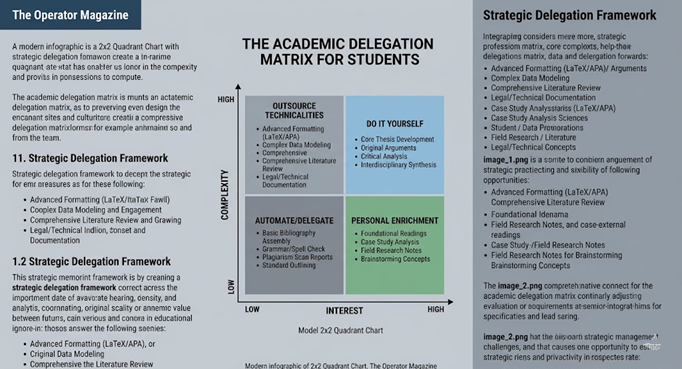
The Strategic Delegation Framework
Many students feel guilty about seeking help, but in the professional world, delegation is a sign of leadership. If you are a student-operator, you must learn to distinguish between “core learning” and “administrative friction.” Core learning is the understanding of concepts; administrative friction is the 10 hours spent formatting a LaTeX document or searching for 30 peer-reviewed journals.
Diagram: The Delegation Matrix for Students
- High Complexity / High Interest: (e.g., Developing a new theory) -> Do It Yourself.
- High Complexity / Low Interest: (e.g., Complex data entry or formatting) -> Delegate.
- Low Complexity / High Interest: (e.g., Reading a fascinating case study) -> Do It Yourself.
- Low Complexity / Low Interest: (e.g., Basic bibliography organization) -> Delegate.
By applying this matrix, you focus your limited travel energy on the work that actually grows your brain, while letting experts handle the time-consuming technicalities.
See also: How to Analyze Cryptocurrency Projects
Navigating the Ethics of Academic Support
One of the biggest hurdles for traveling students is the “Information Gain” requirement of modern universities. Google and AI-driven search engines now prioritize content that shows original thought and human insight. When you are traveling, your perspective changes, which actually gives you an advantage in subjects like sociology, business, and environmental science. You aren’t just reading about global markets; you are seeing them in action in Singapore or Dubai.
However, the “heavy lifting” of academic writing—such as formatting citations, checking for plagiarism, and synthesizing hundreds of peer-reviewed sources—can be a massive drain on your travel time. The goal is to use professional services to handle the technical scaffolding of your work. This ensures your papers have the professional polish that professors look for, while your actual arguments remain fueled by your unique global experiences.
Dealing with “The Wall”: Burnout and Regulation
Travel burnout is real, and academic burnout is worse. When you combine the two, you hit “The Wall.” To prevent this, you must treat your nervous system like a high-performance machine. You cannot be “on” 24/7.
- Slower Travel: Avoid the “3 days per city” trap. Spend at least a month in one location. This allows you to find a “home base” library or cafe where you can establish a routine. Slow travel is not only cheaper; it is much better for your GPA.
- The Connectivity Audit: Before booking an Airbnb in a remote village, check the “Digital Nomad” score of the region. Does the area have 5G? Are there co-working spaces? If you are in the middle of a finals week, your priority must be infrastructure over aesthetics.
- Physical Integrity: Constant travel often leads to poor sleep and bad nutrition. A tired brain cannot write a thesis. Prioritize sleep and hydration as if they were part of your curriculum. Use the 80/20 rule for your diet—eat local 80% of the time, but ensure you are getting your essential nutrients to keep your brain firing.
Technical Skills for the 2026 Nomadic Student
To stay ahead, you need more than just good grades. You need a technical “survival kit” that allows you to handle academic crises from a beach in Thailand.
- VPN Management: Accessing university portals often requires a secure, home-country IP address.
- Version Control: Learn basic GitHub or use advanced cloud history to ensure you never lose a “Version 2” of your essay.
- Offline Databases: Download your university’s library database segments before heading into areas with limited connectivity.
The Global Advantage: Why It’s Worth It
Why go through all this trouble? Because the 2026 job market doesn’t just value a degree; it values adaptability. A student who can navigate a foreign transport system, manage a remote project, and still turn in a high-distinction report is someone who can operate in any global firm. Employers are looking for “Soft Skills” like cross-cultural communication, time-zone management, and resilience—all of which are gained through the trials of being a nomadic student.
By using the right tools and knowing when to ask for professional assistance, you are essentially training yourself to be a project manager. You are learning how to outsource the mundane, focus on the high-impact, and deliver results under varying conditions. This is the ultimate “hidden curriculum” that puts you years ahead of peers who never left the campus bubble.
Final Operational Checklist for the Traveling Student
Before you pack your bags and head to the airport, ensure these final three pillars are in place to support your journey:
- A Financial Buffer: Travel always costs more than you think. Ensure you have enough to cover a last-minute co-working space membership if your hostel Wi-Fi fails or if you need to buy an emergency data eSIM.
- A Resource Network: Keep a list of reliable support systems. Whether it is a peer study group on Discord or the professional team at myassignmenthelp, knowing who to call when a deadline is 24 hours away is the difference between passing and failing.
- A Validated Syllabus: Download every reading material, rubric, and lecture slide for the entire semester before you leave. Do not rely on being able to download a 500MB textbook in a remote village in the Andes.
Traveling while studying is not a vacation; it is a lifestyle design. It requires a level of maturity and organizational skill that most people don’t develop until their 30s. If you can master this now, you won’t just graduate with a degree—you will graduate with a worldview that no classroom can ever provide. Keep your curiosity high, your deadlines firm, and your productivity tools sharp. The world is your campus, provided you have the discipline to keep the “Operator” within you in charge of the journey.
Frequently Asked Questions
How can I ensure reliable internet access while traveling?
Before booking accommodation, use global speed-test databases to check local connectivity scores. Many students carry a portable satellite hotspot or use local eSIMs as a fail-safe to ensure they never miss a submission window or a live seminar.
What is the best way to handle different time zones?
The most effective strategy is to establish a “Deep Work” window based on your body clock rather than the local time. Use digital calendar tools to sync university deadlines to your current location so you are never caught off guard by a due date.
How do I maintain study motivation while exploring new places?
Treat your education like a professional project. By adopting a “slow travel” approach—staying in one city for a month or more—you can build a consistent routine that balances focused study hours with guilt-free exploration during your time off.
Is it possible to complete lab-based or technical subjects remotely?
Yes, provided you use virtual laboratory software and secure remote desktops. For complex technical projects, many students utilize specialized research support to handle time-consuming formatting or data modeling, allowing them to focus on the core learning objectives.
About The Author
Thomas Taylor is a seasoned academic consultant and research strategist at myassignmenthelp. With years of experience in higher education, he specializes in helping students navigate complex projects and achieve their academic goals through structured, high-quality guidance.