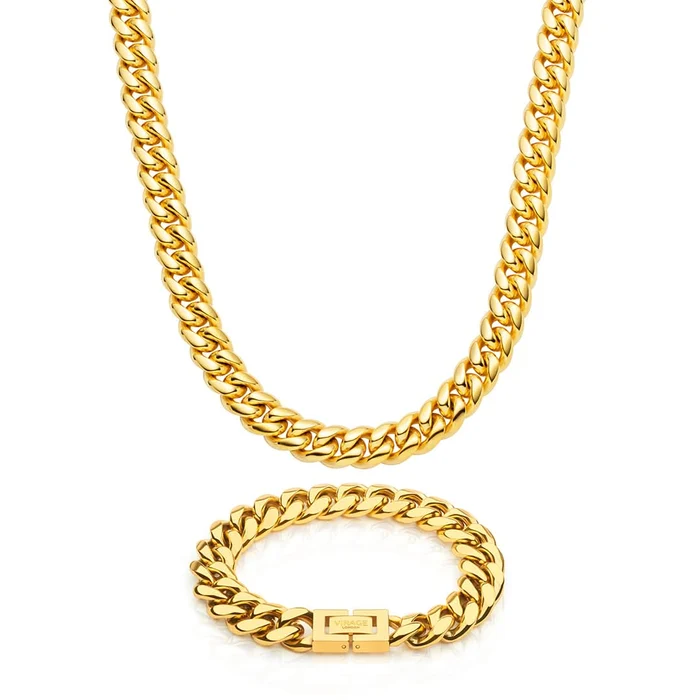
A men’s jewellery set can bring several accessories together around a consistent style. Instead of selecting every piece separately, a coordinated set may include a chain, bracelet, ring, earrings, or pendant that share a similar metal, finish, or design language.
Sets can range from simple two-piece combinations to larger collections containing several accessories. The right selection depends on personal style and how often the jewellery will be worn.
Mens jewellery sets can make it easier to coordinate multiple accessories, especially when the pieces share a similar design, finish, or style.
Begin With the Main Piece
Every jewellery combination needs a starting point. For many men, that piece is a chain or bracelet.
A necklace tends to draw attention toward the face and upper body. A bracelet adds detail around the wrist and can work naturally alongside a watch. A ring creates a smaller focal point on the hand.
Starting with one main piece makes it easier to decide how much additional jewellery is needed.
A large chain may already provide enough visual weight for the upper body. A slimmer chain leaves more room for a bracelet or ring.
Chains Provide a Strong Foundation
Chains are among the most versatile pieces in men’s jewellery collections. Different link styles create very different appearances.
Cuban links have a broad, interlocking structure. Figaro chains combine shorter and longer links. Franco chains have a compact V-shaped pattern. Box chains offer a more geometric appearance.
The choice should reflect existing clothing and accessories. A simple chain can work across a wide range of outfits, while a heavier style creates a more noticeable look.
Chain length also matters. Shorter lengths tend to sit near the neckline, while medium and longer chains provide more space for layering.
Add a Bracelet for Balance
A bracelet can balance the visual weight of a necklace by introducing another accessory around the wrist.
Metal bracelets can coordinate directly with the necklace. Leather bracelets create contrast and can make a jewellery set feel more casual.
The bracelet should be comfortable during everyday activities. Consider the clasp, width, weight, and fit before selecting it.
A bracelet that is too loose may move constantly around the wrist, while one that is too tight can become uncomfortable.
Rings Add Smaller Details
Rings can complete a jewellery set without requiring a large design. Simple bands are easy to combine with necklaces and bracelets.
Signet rings offer a more traditional appearance and can serve as a central hand accessory. Textured or engraved rings provide additional detail.
The number of rings should suit the wearer’s comfort and clothing style. One or two well-chosen rings may create enough detail without making the hands look overloaded.
Consider which hand already wears a watch or bracelet. Distributing accessories across both wrists and hands can create better balance.
Watches Can Be Part of the Overall Look
Although watches are often treated separately from jewellery, they can influence how a complete accessory combination appears.
A gold-toned watch paired with a silver necklace may create a mixed-metal look. That can work, but it should feel deliberate.
For a coordinated appearance, match the watch metal to at least one other accessory. The watch strap also matters. Leather creates a more traditional effect, while steel or other metal bracelets can produce a more unified jewellery appearance.
Decide Whether Metals Should Match
Matching metals is the simplest route to a coordinated jewellery set. Gold necklace, gold bracelet, and gold-toned ring create a consistent colour palette.
Mixed metals offer more flexibility. Silver and gold can be combined successfully when the proportions are considered carefully.
One approach is to use one metal as the dominant colour and the second as a smaller accent. For example, a silver chain can remain the main piece while a gold-toned ring introduces contrast.
Consider Your Clothing
Jewellery should relate to the clothes rather than exist separately from them.
Casual outfits can support more relaxed combinations. A T-shirt, jeans, trainers, chain, bracelet, and simple ring can create a balanced everyday appearance.
Smart-casual clothing often benefits from medium-sized accessories. A button-down shirt, trousers, watch, and discreet chain can provide detail without looking overly decorated.
Formal clothing generally calls for restraint. A watch, ring, or thin chain may be enough depending on the dress code.
Think About Proportion
The size of each jewellery piece should make sense alongside the others.
A thick chain combined with a very large bracelet and several oversized rings can make the accessories dominate the outfit. A medium chain with a slimmer bracelet and simple ring creates a quieter combination.
Proportion also relates to body frame and clothing fit. Loose clothing can accommodate larger accessories, while fitted clothing may work better with smaller pieces.
These are styling guidelines rather than fixed rules. Personal preference remains central.
Choose Pieces That Can Be Worn Separately
A useful jewellery set should not require every item to be worn at the same time.
A chain should work on its own. The bracelet should also suit outfits without the necklace. Rings can be worn independently.
This gives the collection greater flexibility. One day may call for a simple chain, while another outfit may suit the full combination.
Buying versatile pieces also makes it easier to adapt jewellery to different occasions.
Pay Attention to Storage and Care
Multiple jewellery pieces require sensible storage. Keeping chains separated can reduce tangling, while rings and bracelets should be stored where they are less likely to scratch one another.
Cleaning methods depend on the metal and finish. Follow the manufacturer’s instructions rather than applying a single cleaning method to every item.
Remove jewellery before activities that expose it to harsh chemicals, unnecessary impact, or conditions that may damage its finish.
Build the Collection Gradually
A complete jewellery collection does not need to be purchased at once. Start with pieces that receive regular use and add accessories that complement them.
A chain may be the first purchase, followed by a bracelet and ring. A pendant or second chain can be introduced later for outfits that need a different appearance.
This gradual approach also makes it easier to identify which metals, widths, lengths, and designs feel comfortable.
Mens jewellery sets work best when the individual pieces remain useful beyond the complete combination. A coordinated collection can provide plenty of styling options without requiring every accessory to be worn together. By paying attention to proportion, metal choice, comfort, clothing, and personal taste, each piece can contribute to a complete look while still standing confidently on its own.