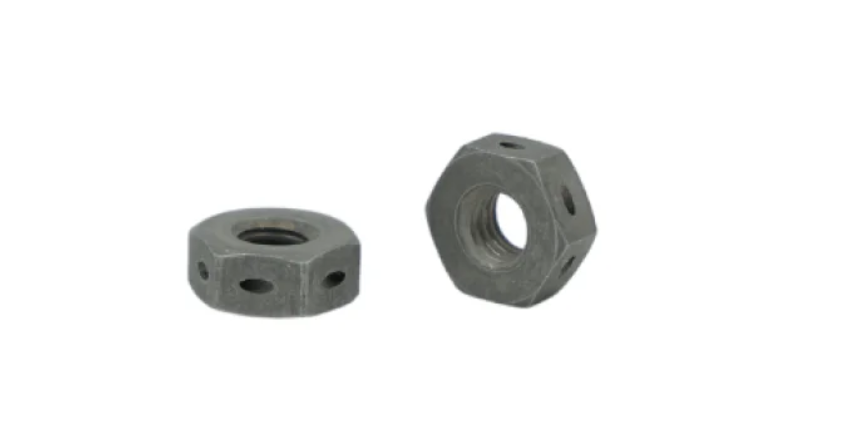
A full-height nut often looks like the safe default option, until it meets a rod end, bracket or bearing housing with only a few millimetres to spare. In tight mechanical layouts, the extra height can push parts out of position or block a spanner. NAS 509 jam nuts answer this space question with a thinner hexagon profile.
NAS 509 jam nuts give designers a thin, drilled hexagon nut with UNJF class 3B threads, which locks rod ends, linkages and adjusters firmly in place where a standard nut will not fit. They come in alloy steel and corrosion-resistant grades, in right-hand and left-hand threads, so one standard covers a wide range of compact locking and adjustment needs.
Clearance Shapes the Choice of Nut
Height Adds Up in Tight Layouts: A full-height nut may not suit layouts where a thread end sits close to a bearing, a housing wall or a moving part. Its extra height adds length to the stack, which may call for a longer bolt, a bigger cover or a shifted bracket. Each change moves other parts away from their intended positions.
Late Clearance Checks Cost More: In everyday assembly and maintenance work, technicians routinely see parts which were redesigned late because the nut chosen on paper would not clear a neighbouring component. The longer this check waits, the more drawings, tooling and stock it touches. A clearance review at concept stage keeps the low-profile option open while the layout can still change.
Low-Profile Jam Nuts Support Compact Adjustment
How a Jam Nut Holds Position: A jam nut is a thin nut which locks a threaded part in place by tightening against another nut or a fixed face. The clamping force loads the threads in opposite directions, which resists turning under vibration. On rod ends and control linkages, this lets a technician set a length and then hold it securely.
Drilled and Left-Hand Options: This standard includes three drilled holes for safety wire, which gives a visible second lock on flight controls and other inspected joints. Left-hand versions lock the opposite end of rods threaded left and right, so turning the centre tube lengthens or shortens the link without removing either end fitting. This keeps rigging adjustment quick on the hangar floor.
Jam Nuts Compared with Full and Self-Locking Nuts
Full Nuts Carry More Tension: A full-height nut engages more threads, so it carries a higher tensile load and remains the right choice for primary structural bolts in tension. A jam nut has fewer engaged threads and suits locking, adjustment and shear-loaded joints. Where the drawing permits, NAS 509 jam nuts free up space without changing the bolt or bracket.
Self-Locking Nuts Sit Taller: Self-locking nuts with nylon or all-metal inserts hold without safety wire and install quickly, which suits many production lines. They are usually taller than a jam nut, and nylon inserts carry temperature limits. A thin drilled jam nut paired with safety wire gives a low-profile lock which inspectors can confirm by eye.
See Also: What to Consider When Choosing a Pia
Engagement, Mating Parts and Loads Guide Selection
Thread Engagement Comes First: Thread engagement is the length of thread shared between nut and bolt, and it sets how much load the joint can carry. NAS 509 jam nuts use UNJF threads with a rounded root, which spreads stress well. The bolt should still project at least one full thread beyond the nut, so the whole nut height carries load.
Mating Parts, Access and Heat: The mating thread, washer and clamped part should match the nut in material and finish so the joint behaves as one unit. Where steel nuts clamp aluminium parts in hot zones, thermal expansion changes preload as temperatures cycle. Installation access matters too, since a thin nut needs room for a spanner and a backing tool together.
Fitting Tight Spaces While Meeting the Drawing
A Simple Clearance Study: Engineers can assess space constraints by modelling the full stack of bolt, washers, nut and tool swing in the CAD assembly before parts are ordered. The study should confirm thread protrusion, spanner access and safety wire routing at the extremes of travel. If the jam nut fits and meets the load case, the layout can stay compact.
Low-Profile Locks Pay Back: A jam nut with safety wire gives inspectors a quick visual check of position during preventive maintenance, which keeps inspection visits short and predictable. Corrosion-resistant grades hold their finish in wet or salt-laden air. Over the life of an assembly, the right low-profile nut keeps adjustments stable and reduces time spent resetting linkages.
Pre-Specification Checks for Thin Hex Nuts
A Drawing-Stage Review: A short review at the drawing stage saves rework later and keeps the assembly on schedule. The points below cover what a design or maintenance engineer should confirm on paper before specifying NAS 509 jam nuts for a new linkage, an adjuster or a compact bracket joint in an existing product line.
- The joint carries locking, adjustment or shear load rather than primary tension.
- The thread hand, size and pitch match the mating rod end or bolt.
- At least one full thread projects beyond the nut once tightened.
- There is room for two spanners and safety wire.
Compact Joints Start with a Clear Load Case
A low-profile jam nut chosen against a clear load case keeps linkages locked and layouts compact through years of service. Leaving the choice until late in a project tends to add redesign, extra parts and longer lead times. Get in touch to share your drawing, and request a quotation for certified aerospace jam nuts in the grade you need.